
THE UNIVERSITY OF SASKATCHEWAN’S MAIN CAMPUS IS SITUATED ON TREATY 6 TERRITORY AND THE HOMELAND OF THE MÉTIS.
THE UNIVERSITY OF SASKATCHEWAN’S MAIN CAMPUS IS SITUATED ON TREATY 6 TERRITORY AND THE HOMELAND OF THE MÉTIS.
VICTORIA MARTINEZ
News Editor
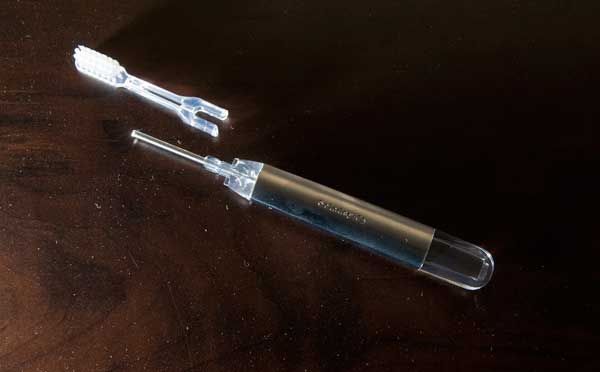
University of Saskatchewan dental researchers have been working on the world stage studying the cleaning properties of a Japanese-made solar toothbrush.
The Soladey-J3X, produced by the Shiken company of Japan, is already on the market in Asia and Europe, as well as online, but the company approached the U of S to perform an independent study.
The toothbrush doesn’t look like a science fiction toy but much like a regular toothbrush: simple bristles, thin neck and a thick metallic body. The trick is in the neck, where a titanium rod is fitted under clear plastic.
At the other end, there’s a discreet solar panel, which does not charge a battery, as you might imagine, but transfers electrons directly to the rod in the brush via a simple wire.
Titanium oxide, the semiconductor in the toothbrush, acts as a conductor when exposed to light and moisture.
When light hits the panel, it transfers electrons through the titanium rod, which in turn spits out energized electrons to break down plaque on teeth.
“The rod has an indefinite lifetime. The bristles wear out like any other toothbrush, so that’s the part you have to replace,” said Dr. Gerry Uswak, the principal investigator for this research.
Two third year dentistry students, Jin Hwa Lee and Ka Yi Jennifer Li, worked on researching the effectiveness of the brush. They performed the necessary dental examinations, compiled and presented the data. The research was done for a third year table clinic class, which all dental students must go through.
These two won third place at an international dental symposium in Hong Kong for their research poster, among dental professionals and seasoned researchers.
Their supervisor was Dr. Jay Hoover, who also worked on research 15 years ago on the prototype for this toothbrush. The original lacked the solar panel, which the creators hope will boost the reaction’s energy.
“Plaque, called a biofilm now, is made of bacteria,” explained Hoover.
“The bacteria themselves make a gooey substance, which is known as the matrix. So when you rinse your mouth it’s not going to get rid of that gooey substance, it’s like glue.” explained Hoover.
Throughout this matrix, the compounds in the matrix contain positively charged hydrogen particles. Electrons, which are negatively charged, pull these away, like miniature magnets.
“The theory is it disrupts the matrix. It makes it easier for the bristles to remove the plaque.”
The study was performed over three months on U of S students of all colleges, in a randomized double blind crossover study, which means all students involved were tested after their normal dental routine, with a placebo brush, and using the Soladey-J3X, though who was using what brush in what trial was unknown.
“If you’re doing a clinical study on toothbrushes you may not want to use dental students. You know, they may be a little bit biased towards better dental hygiene,” said Uswak of previous studies done with exactly that group.
This study’s aim was to see if there were real-world benefits to the brush.
The results were positive. On the outsides of teeth, and between them, the solar brush showed reduced bleeding and plaque scores, signs of gingivitis.
Aside from being technologically cool and waste elimination (one only replaces the toothbrush head since the body is reusable), the new toothbrush could help specific groups, said Dr. Uswak.
“It would be especially beneficial for folks who for whatever reason can’t brush correctly. There’s a whole bunch of people our there who can’t tolerate toothpaste. You can use this with or without.”
– –
image: Pete Yee

Leave a Reply