
THE UNIVERSITY OF SASKATCHEWAN’S MAIN CAMPUS IS SITUATED ON TREATY 6 TERRITORY AND THE HOMELAND OF THE MÉTIS.
THE UNIVERSITY OF SASKATCHEWAN’S MAIN CAMPUS IS SITUATED ON TREATY 6 TERRITORY AND THE HOMELAND OF THE MÉTIS.
ALISON COOLEY
Arts Writer
This week, the Snelgrove Gallery hosts three graduating exhibitions which take up themes of stillness, memory and memorial.
In Kelly Yanko’s show Nimbus, painting serves as a vehicle for experimentation and contemplation. Kristen Brown’s large-scale chalk pastel drawings imitate photography to comment on memory and impermanence. Meanwhile Alexa Hainsworth’s multi-media installation is yet another kind of meditation, one that considers nature and loss.
For Kelly Yanko, painting is about a process of discovery, experimentation and contemplation. In her large, non-objective paintings she explores the atmospheric elements of colour relationships.
“I wanted to build the layers up very, very slowly, so that involved laying the canvas down on the ground and pouring very thin wash over top, and then combining pastel chalks and that kind of thing together,” Yanko explained.
After one layer had settled, Yanko would decide what would happen with the next.
“I wanted there to be different planes, but very slightly. I didn’t want any of them to look particularly over edited or over finished.
“I wanted to reveal the process and not just completely render it. So it’s not done for the viewer. The viewer has to interact with it in that sense,” she continued.
Yanko’s work is also about contemplating her own painting practice, her processes and methods of working and engaging with new ways of using paint. In this series of works, Yanko articulates a distinct shift away from her previous works, which used thick paint in bright, pure colours. Here Yanko uses a subtle and refined colour palette, creating restful and enchanting forms and abstractions. There is a definite sense of tranquility in Yanko’s paintings.
“I wanted it to be calm. I don’t know if that’s a reaction to the winter we experience and the snow and quiet… There is a stillness I wanted to create.”
Kristen Brown’s show It’s All a Blur consists of a series of large-scale chalk pastel drawings. Brown uses imagery from her own personal photography and works up the surface of the chalk pastel drawings to a high level of finish, incorporating photographic distortions and vivid colour reflections in her images.
When asked why she uses chalk pastel, Brown answered, “I like the mysteriousness, the blurs. It gives them an interesting quality.”
Some of the drawings feature Brown herself, in the kinds of self-portraits common to popular casual photography. Unlike typical portraits, however, the images are obscured by what might otherwise be considered photographic flaws: blurs, glares and multiple-exposures, rendered carefully in layers of chalk pastel.
In working from her own personal images, she is interested in constructing an ambiguous narrative from “moments and snapshots.” This narrative is populated by familiar figures but with enigmatic references to place and time.
With these images, Brown revealed, she’s interested in commenting on “people coming and going, permanence, impermanence.”
In her paintings and sculptures, Alexa Hainsworth works from her own memories of her childhood refuge in nature.
“The show comes from, I think, my love for the prairies and Saskatchewan,” said Hainsworth. “It sprung from my father leaving his Bison ranch… which was pretty sad for me. They got rounded up and put on the truck and that was the end of it. It was such a part of my childhood and now it’s a place I can’t go.
“And then I also felt the same a lot about my friend’s father passing. He also lived in a rural community, and, as a teenager, you want to kind of get away from the city and have your own space to run around in and be crazy, and that’s what I did a lot, so he was kind of another father figure for me.”
Yet the title of Hainsworth show came from another rural hero.
“With Lily Plain, Marie, my mother’s best friend, passed away last Christmas from cancer…. She took from the land and she made berry jam, called Lily Plain jam. And so these three people in my life lived off the land and enjoyed nature and they meditated on nature and it spoke to them.”
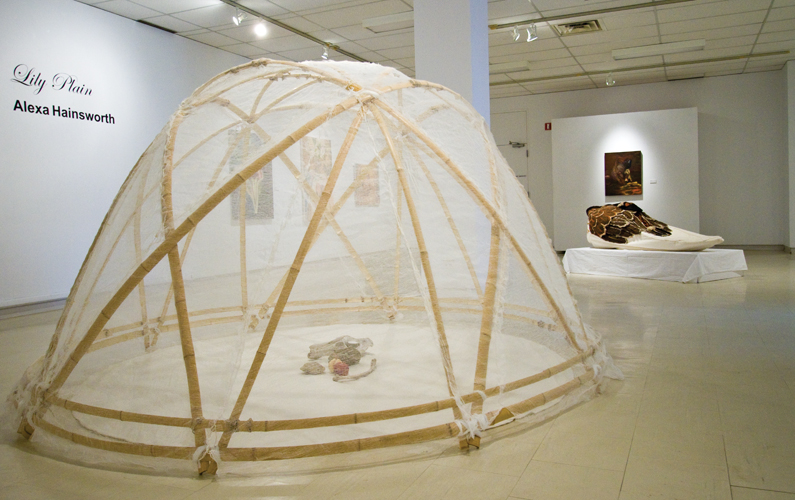
Hainsworth herself meditates on nature in the process of creating her own work and the result is an exhibition that is at once contemplative and dynamic. A large sculptural dome fills the middle of the gallery. Paired with a hand-sewn death shroud in the shape of a giant goose, this work becomes a way of memorializing both the landscape and her own personal loss.
“I thought the dome could be for people visiting the death shroud or it could be left as something that mimics the shape of the horizon line, as a visual marker from a far distance,” Hainsworth described. “So I’ve been remembering the landscape, even though I’m not there anymore.”
Although Hainsworth’s subject matter is mournful and sombre, her vivid and expressive paintings convey a more ambiguous view of our relationship to nature.
“Even though the subject is sad, I paint it in a way that is very celebratory,” Hainsworth explained. “They’re colourful and they’re wild and I think that’s really about the energy of life and death.”
In the paintings that line the walls of the gallery, Hainsworth freezes her animal subjects in moments of action that teeter between life and death: a bison lurches into the mud, a coyote treads tenderly in the ice and snow. Other works are more overt remembrances, attempts to capture the essence of her subjects and their impact on herself and the landscape.
“I think when someone passes away,” Hainsworth added, “when you look around at nature or wilderness or wildlife, sometimes you can catch a glimpse of that person in them.”
– –
photo: Robby Davis
Leave a Reply