
THE UNIVERSITY OF SASKATCHEWAN’S MAIN CAMPUS IS SITUATED ON TREATY 6 TERRITORY AND THE HOMELAND OF THE MÉTIS.
THE UNIVERSITY OF SASKATCHEWAN’S MAIN CAMPUS IS SITUATED ON TREATY 6 TERRITORY AND THE HOMELAND OF THE MÉTIS.
 HOLLY CULP
Sports Writer
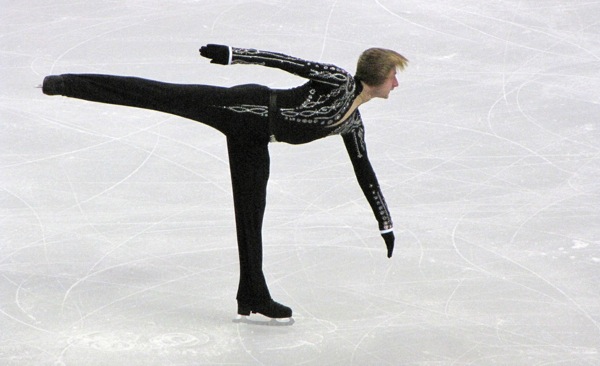
After losing out on the gold medal to American figure skater Evan Lysacek, Russia’s Evgeni Plushenko upgraded his silver medal to “platinum” on his official website.
This is more than just being a sore loser; this comes down to a single element in the world of figure skating: the quadruple jump. Plushenko was quoted after the men’s short program that “if it is not quad, it is not men’s figure skating.”
The quadruple jump was first landed in competition in 1988 by Canada’s very own Kurt Browning. After that, if you were not landing your quad jumps in men’s figure skating, you simply were not winning medals. The fact that the quadruple jump is extremely dangerous for skaters was ignored in favour of proving oneself to the sport.
Under the old scoring system, skaters were awarded points for overall technical merit. Since 2002 and the Sale-Pelletier clusterfuck, the system has changed and so has everything else about the sport.
Before, in the 6.0 system, a skater would be awarded scores for overall technical merit in the freeskate, required elements in the short program, and presentation in both. In this system, your score would likely be pretty high if you happened to land a quadruple jump. More attention was given to technical perfection, especially in jumps.
Since 2002, the idea that the quadruple jump is the equivalent to ultimate dominance in this extremely technical sport is a tired remnant of a fast-declining school of thought.
In the new system, points are awarded individually for each element (an element being a specific jump or spin), so if you include a quadruple jump followed by a triple jump in your program and fuck it up, you’re going to be out about 16 points. On top of that, the program component mark — which includes choreography, interpretation, transitions and footwork — is more precisely marked and important than in the previous system.
If you’re wondering why Plushenko didn’t make the cut, it may have been because Lysacek’s was better artistically and his jumps were better executed. Also, this part of the scoring system saved Canadian Patrick Chan because he had possibly the best choreography in the entire competition but a weaker technical performance.
Another beef I have with Plushenko is that he has been retired for three years, already has his Olympic gold medal and didn’t even practice his routine the morning of the freeskate competition. In the end, Evan Lysacek was more practiced and better suited to win the gold medal. He worked harder than anyone for that medal. He didn’t just show up after a three year hiatus and say, “You know what? I think I’ll compete in the Olympics today!”
There used to be a time when the quad was essential for dominance in male figure skating. There also used to be a time when Russian figure skaters would strike fear in the hearts of skaters all over the world. Both of these things are coming to an end.
The fact is a lot of skaters are not willing to use the quad in competition even if they can land it. It is too dangerous, exhausting and, in the end, probably not worth it. Patrick Chan put it best in his Tiger Woods analogy: “Tiger Woods has a driver in his golf bag, but he doesn’t always use it.” Chan’s belief that the quad gets too much attention and distracts from the artistry of the sport is dead on.
– –

Leave a Reply