
THE UNIVERSITY OF SASKATCHEWAN’S MAIN CAMPUS IS SITUATED ON TREATY 6 TERRITORY AND THE HOMELAND OF THE MÉTIS.
THE UNIVERSITY OF SASKATCHEWAN’S MAIN CAMPUS IS SITUATED ON TREATY 6 TERRITORY AND THE HOMELAND OF THE MÉTIS.
GRAHAM ANDERSON
The Peak (Simon Fraser University)
BURNABY, B.C. (CUP) – Copenhagen was a failure. Few would contest that the non-binding “Copenhagen Accord” is anywhere close to sufficient in confronting the problem of global warming. The outcome of the conference fails to address the graveness of the problem in an effective way, leaving the survival of the world’s most vulnerable people in question.
I had the opportunity to attend the United Nations Climate Change Conference in Copenhagen as a member of the Canadian Youth Delegation, a diverse group of more than 30 young people from across Canada including policy experts, communications gurus and experienced activists.
Our goals were to learn about the process, engage with the Canadian negotiating delegation and get messages back home about what was really occurring. We worked in collaboration with global youth and Canadian environmental organizations to hold our leaders accountable at the conference. From this perspective, I would like to share what really happened in Copenhagen.
The UN Climate Change Conference has taken place every year for the past 15 years, but the Copenhagen meeting was of special importance. The Bali Action Plan, agreed to at a 2007 UN Conference, set out the Copenhagen meeting as the deadline for a full, legally binding treaty that would succeed the Kyoto Protocol, which expires in 2012. The conference was set to establish emission reduction targets, adaptation and clean technology financing for developing nations, as well as governance mechanisms for the overall framework.
With the consequences of inaction becoming increasingly harmful and irreversible, the Copenhagen Conference marked a critical point in our history.
At the core of negotiations in Copenhagen was the fact that climate change represents a dramatic injustice between those responsible and those who suffer the impacts.
While developed countries have produced the majority of the greenhouse gas emissions that cause climate change, it is the developing nations that are most affected by the devastating consequences of this global crisis.
The sea-level rise associated with climate change is already creating environmental refugees from islands in the South Pacific. The world’s first climate-related evacuations were conducted on the Carteret Islands in 2009. Beginning in 2005, the islands began to flood, becoming progressively more unlivable.
The current distribution of emissions further highlights the injustice of climate change — 20 per cent of the world’s population in the developed world is responsible for 50 per cent of current global warming pollution. Given this substantial difference, unless developed countries pledge dramatic cuts in pollution, it is difficult to make any honest case for reductions in developing nations’ emissions. Developed countries have a unique historical responsibility for the consequences of climate change and a burden to generate effective solutions that are fair and ambitious.
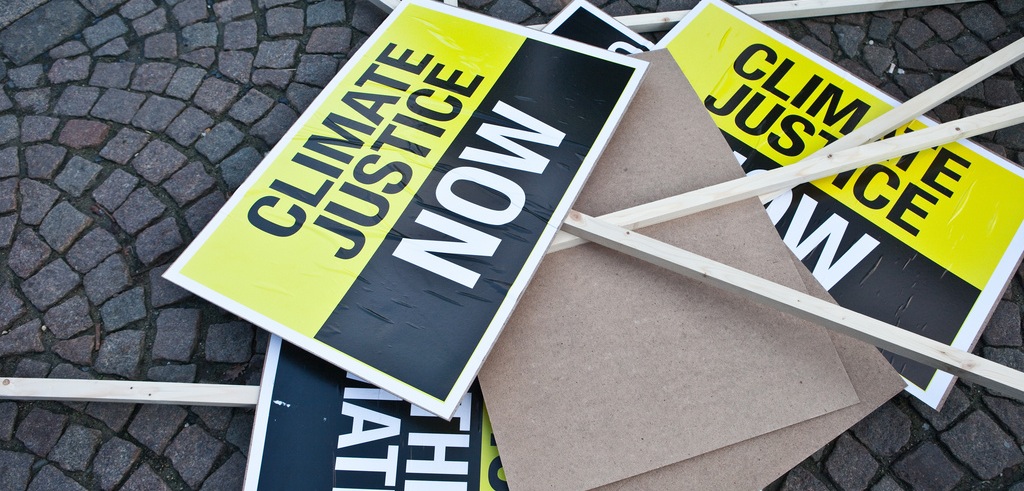
What we need is climate justice: solutions that recognize climate change as an unjust global problem and that it is the responsibility of the developed world to solve it. In the words of the Global Humanitarian Forum, climate justice means that “people everywhere are safe from danger and free from suffering due to climate change.”
A global coalition of civil society organizations — including religious, labour and environmental groups — was calling for exactly that in Copenhagen: a fair, ambitious and legally binding deal.
Such a treaty would require dramatic cuts from developed nations that would bring carbon emissions to equitable levels globally. It is widely accepted that reductions of at least 25 to 40 per cent from 1990 levels by 2020 will be necessary to maintain some chance of avoiding the worst effects of climate change. In the long term, emissions would need to be kept within a global carbon budget that would permit less than half of proven fossil fuel reserves to be combusted. If reductions on this scale are achieved in the developed world, the world’s people will be much closer to having fair access to atmospheric space.
Climate finance will be another important component of any effective deal. Again recognizing historical responsibility, developed nations should adequately fund adaptation to climate change in vulnerable nations and emission reduction efforts in developing nations. Critically, this finance should be additional to aid funding and be democratically managed by affected nations so that funds may be distributed to where they are most needed.
It has been estimated that US$200 billion per year will be required for vulnerable nations by 2020. By contrast, the rich countries collectively spent trillions of dollars last year on bailouts and stimulus.
Finally, any effective deal would need to be as legally binding as the Kyoto Protocol was, but with additional economic penalties for countries that miss their targets, similar to the more successful global agreement confronting ozone-harming pollution.
Unfortunately the Copenhagen Accord announced at the end of the climate conference was not a fair, ambitious or binding deal. While the text in both the UN process and the Copenhagen Accord aims for a target of two degrees warming, analysis has shown that the targets brought forward will commit the planet to at least a three-degree increase. This difference potentially represents hunger for hundreds of millions of people and billions of dollars of lost economic productivity.
The accord is an incredibly vague document that takes steps back from previous commitments and alleviates developed countries of any specific responsibility for reductions or finance. Instead, it allows nations to fill in their own figures over the next year as they please.
But there were some advances. The inclusion of the U.S. and major developing polluters like India, China, and Brazil is unprecedented, as these countries did not have commitments under the Kyoto Protocol. Also, a finance goal of $100 billion per year by 2020 was announced for vulnerable nations — half of the estimated need — although it will be up to each nation to decide on their contribution according to their own criteria.
Fundamentally, though, the Copenhagen Accord is a weak, non-binding document, not even formally agreed to by all UN member countries. It is unacceptable that world leaders have committed to such a low level of ambition given the necessity of decisive action on this crisis.
Throughout the conference there was a fundamental divide between rich, high-polluting nations and poor, vulnerable nations. In negotiations, groups of countries form in blocs, and these blocs work together to present their shared positions. Generally, developing nations are pushing for the kind of fair, ambitious and binding deal described above. Rich nations, however, attempt to shirk their responsibility for problems and avoid any commitment to solutions. Negotiating blocs from the most vulnerable countries, such as the Alliance of Small Island States and the African Bloc, frequently walked out of talks to protest the most aggressive positions (and the lack of action) taken by developed countries.
At the centre of the conflict for the majority of the conference was the fundamental architecture of the agreement and the preservation of the Kyoto Protocol. In the Kyoto Protocol, the difference in historical and current responsibility was clearly laid out by drawing a line between developing and developed countries. For developing nations, it is critically important to maintain this agreement to avoid losing that important distinction.
Additionally, developing nations were upset that proposed reductions were far from what is necessary to solve the problem and reduce future suffering for their people. Their calls for stronger targets from rich countries were unanswered, leading to further frustration.
Unfortunately, the discussions that did take place were often unproductive. Negotiators could rarely come to agreement on petty issues, much less on significant ones. Rather than refining the content and agreeing to compromise, the rich nations insisted on positions that do little to address the injustice of climate change. The Canadian government was among the worst at obstructing progress in this way.
At the very start of the conference, amid an atmosphere of hope and cooperation, Canada affirmed that its position was not going to change.
Not surprisingly, Canada’s obstructionist position was backed up by a very weak plan at home. Currently, we are promising to reduce pollution to just three per cent below 1990 levels by 2020, but we don’t have a plan to achieve this. Past Canadian action on climate change has also been ineffective, as it has lacked the market-mechanisms and regulations that would achieve cuts in emissions while creating new jobs. The current Conservative government has announced that we will harmonize pollution reductions with the United States, but we have not made any real strides toward reaching this target either.
In fact, our government is even passing on the most obvious opportunities to reduce emissions. For example, in the recent round of stimulus spending, the U.S. invested 14 times more in energy efficiency and renewable energy per person than Canada. The Alberta tar sands are another missed opportunity: they make the greatest contribution to our rising pollution levels, yet the government does nothing to slow these projects. With this blatant lack of action, our government has demonstrated that climate change is not their priority.
Overall, Canada’s record and current policy on climate change has been ranked among the worst of high-emitting countries, second only to Saudi Arabia. By ratifying the Kyoto Protocol and watching our emissions continue to rise (we’re now 32 per cent over target), we are breaking both domestic and international law.
Notably, none of this is consistent with what Canadians want from our government. Polls have shown that a significant majority of Canadians want our government to do more, and many of us take steps in our daily lives that demonstrate our commitment.
Fortunately, the international process is not completed. This April, a conference is being held in Bolivia to challenge the dominating position of rich nations and highlight the need for climate justice. Later in the year, the UN process continues with meetings in Germany and Mexico. Key UN figures and world leaders have indicated that they hope to achieve the necessary legally binding deal in Mexico next year.
But we are running up against some critical deadlines. For the international process, a new agreement must be in place to extend Kyoto by the end of 2012. More importantly, global emissions must begin to drop before 2020 to maintain a possibility of reaching the critical two-degree target for temperature rise.
As Canadians, we should be concerned about our international reputation given the extent to which our government is falling behind on this issue. We should also be concerned that the Conservative government feels it can ignore the majority of voices calling for this necessary action on climate change.
Ironically, the failure of our leaders also makes us incredibly empowered as Canadian citizens. We are the people behind a government that is currently doing the most to hold back global progress in climate negotiations. Therefore, we can also be the people to replace that government with one that takes this issue seriously. Until that happens, there are still many opportunities to achieve reductions with or without the involvement or support of the federal government. Provincial governments, municipalities, businesses and non-profit organizations have all demonstrated that such action is still possible.
While the scale of citizen engagement on climate change for Copenhagen was unprecedented, the movement must continue to build to the global treaty we need. It is a problem we in the developed world have created, and it is therefore ours to solve.
– –
photo: Flickr / CC BY-NC-SA 2.0

Leave a Reply