
THE UNIVERSITY OF SASKATCHEWAN’S MAIN CAMPUS IS SITUATED ON TREATY 6 TERRITORY AND THE HOMELAND OF THE MÉTIS.
THE UNIVERSITY OF SASKATCHEWAN’S MAIN CAMPUS IS SITUATED ON TREATY 6 TERRITORY AND THE HOMELAND OF THE MÉTIS.
SARAH STEAD
The Gateway (University of Alberta)
EDMONTON (CUP) ”“ If hobbits and orcs aren’t the kind of characters you prefer to cozy up to for a few hours in a movie theatre, then it may come as a pleasant surprise to you that Peter Jackson’s latest film leaves those mythical creatures behind.
Although the visionary director behind bringing J.R.R. Tolkien’s Lord of the Rings trilogy to the big screen is in the process of writing a screenplay for The Hobbit, for the past two years he’s been largely absorbed with bringing Alice Sebold’s bestselling novel The Lovely Bones to life.
“After doing Lord of the Rings and King Kong so close together, I wouldn’t say I was tired of big-budget fantasy films, but I certainly felt that I had to have a break from those type of films,” Jackson said.
“The Lovely Bones was a project that we partly chose because it was so different… As you read a well-written book, you start imagining what these people look like and you imagine the locations and the action, and before too long, you’ve got this little movie playing in your head. And then it doesn’t take much for me to get excited about the little movie that’s being inspired by the words in the book.”
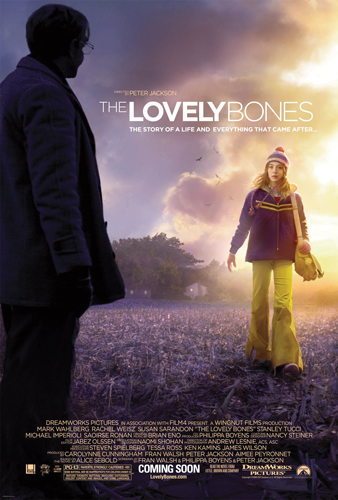
The film centres around Susie Salmon (Saoirse Ronan), a 14-year-old girl who is raped and murdered after being lured into an underground den by a shady neighbour. Her spirit continues to exist in a special in-between world from which she watches her family, hoping to help them find the pieces to punish her killer.
At first glance, the only two things The Lovely Bones and the Rings’ franchise would seem to have in common is that they were originally novels, but according to Jackson, the two projects are a lot more alike than it seems.
“I always make the movies that I’d want to watch,” he said simply. “The movies that I like watching are escapist movies… I have no interest in seeing movies about people like me or you or people that have regular jobs, or live a regular life — those things don’t interest me… I like being swept away into an adventure that I know I’m never going to have in my real life, seeing and meeting characters that I’m never going to meet because they’re so outrageous, or things that happen on screen and they’re never going to be part of my real life.”
In addition to creating the fantastical world that Susie exists in for much of the film, Jackson had questions about mortality on his mind during production. While he’s hesitant to offer his personal outlook on the afterlife, the power to play with the possibilities of the soul’s final destination was “one of the attractive things about The Lovely Bones.”
“That’s obviously a question that we all wonder about. It’s in the back of everybody’s mind, especially if you lose people who are close to you. You wonder what’s happened to them, and (if) they’re still around, and can they see you and hear you? All those sorts of questions are fascinating questions, and they’re emotional questions,” Jackson says.
In a sense, Jackson also got to play God as he decided during the writing of the screenplay which of author Sebold’s characters would come to life on screen and which would stay between the pages of her novel. Some of the cuts had to happen for the simple reason that it wasn’t feasible to make a five-hour-long film, but Jackson mourned the loss of those characters, scenes and subtleties all the same.
“I’m realizing that when you adapt a book, you can only really put half the book into the film,” he sighs. “(There are) passages of the book that you really liked, that you assumed you’d put into the movie, but you suddenly haven’t got time for them.”
It’s difficult, he says, “to say goodbye to characters and to scenes that you were looking forward to doing.”
Despite losing some characters that he was looking forward to meeting, Jackson glows when he talks about the actors who played the characters he did keep. He confesses that after working with Mike Imperioli, he watched every episode of The Sopranos in a span of three weeks. And when it comes to Saoirse Ronan, whom Jackson cast solely from her audition tape, he makes no qualms about predicting the youngster’s future career trajectory.
“She’s an Irish actress, but she puts on a perfect American accent,” Jackson laughed. “She was 13 years old, I think, when we first met her, and cast her in the film… Acting is never about pretending. It’s about making it real — and when she’s crying on screen, she’s really crying, because she’s thinking about things that are making her cry… I think she’s going to have a terrific career. She reminds me of a young Cate Blanchett, actually.”
Jackson also shares that he has a daughter close in age to Ronan, and that despite some of the violent themes, making a film that he could share with his daughter was a priority.
“We felt a responsibility to make it real, but (we didn’t) want to make it gratuitous or explicit. The film’s about a murder, but we don’t show the murder on screen. We didn’t want to do that, because we didn’t want that to be the defining moment of the film. We wanted Susie’s murder (to be) the catalyst that starts our story going. But it’s not a film about her murder. It’s a film about what happens after.”

Leave a Reply